
Emotional intelligence in sales leadership rarely gets first mention when senior leaders appoint a new sales leader or manager.
Often, what comes up more in the discussions are:
- Revenue history
- Quota overachievement
- Big accounts won
- A strong personality who “knows how to close.”
All sensible criteria. All commercially relevant. And yet, these don’t always translate to sales leadership ability.
Promoting high-performing individual contributors into leadership roles can work but only if they receive practical leadership development.
But what receives far less scrutiny is how they will lead under pressure. This means – in real terms, daily – how they handle conflict and whether they can bring the team together in a difficult economic climate with uncertain forecasts.
These skills come under the umbrella of emotional intelligence.
With today’s informed buyers, longer cycles, hybrid teams, and constant target scrutiny, emotional intelligence in sales leadership is one of the clearest drivers of sustained performance.
And when it’s overlooked at the appointment stage, the cost is almost always cumulative.
The Promotion Pattern That Creates Performance Problems
When a leadership role opens up, promoting your top sales person feels logical. You have to almost fight against the idea that excellent individual performance means leadership potential.
But over the longer term, the gap becomes visible. And you may need to make the case for why.
The skills that drive personal success – control, competitiveness, high urgency, self-reliance – don’t automatically translate into leading varied team personalities. In fact, under pressure, they can create the opposite effect.
Here’s where it tends to break down:
- Over-reliance on pressure as a motivator
- Inconsistent coaching conversations
- Emotional volatility when targets slip
- Favoring similar personalities
- Escalating conflict rather than managing it early
Low-EQ leadership is subtle. You’ve likely seen it before – when emotional intelligence in sales leadership was overlooked.
It erodes performance slowly, through morale, turnover, and disengagement.
Reps become cautious instead of confident. Forecasts become political instead of factual. Cross-functional friction increases. And what looked like a strong appointment has generated instability.
Today, you need to always look for evidence of someone’s emotional control under commercial pressure before raising them to sales leadership. It is one of the most reliable predictors of sustainable business growth.
Why Emotional Intelligence in Sales Leadership Directly Drives Performance
If you’re responsible for sales performance, emotional intelligence in sales leadership shows up in your numbers.
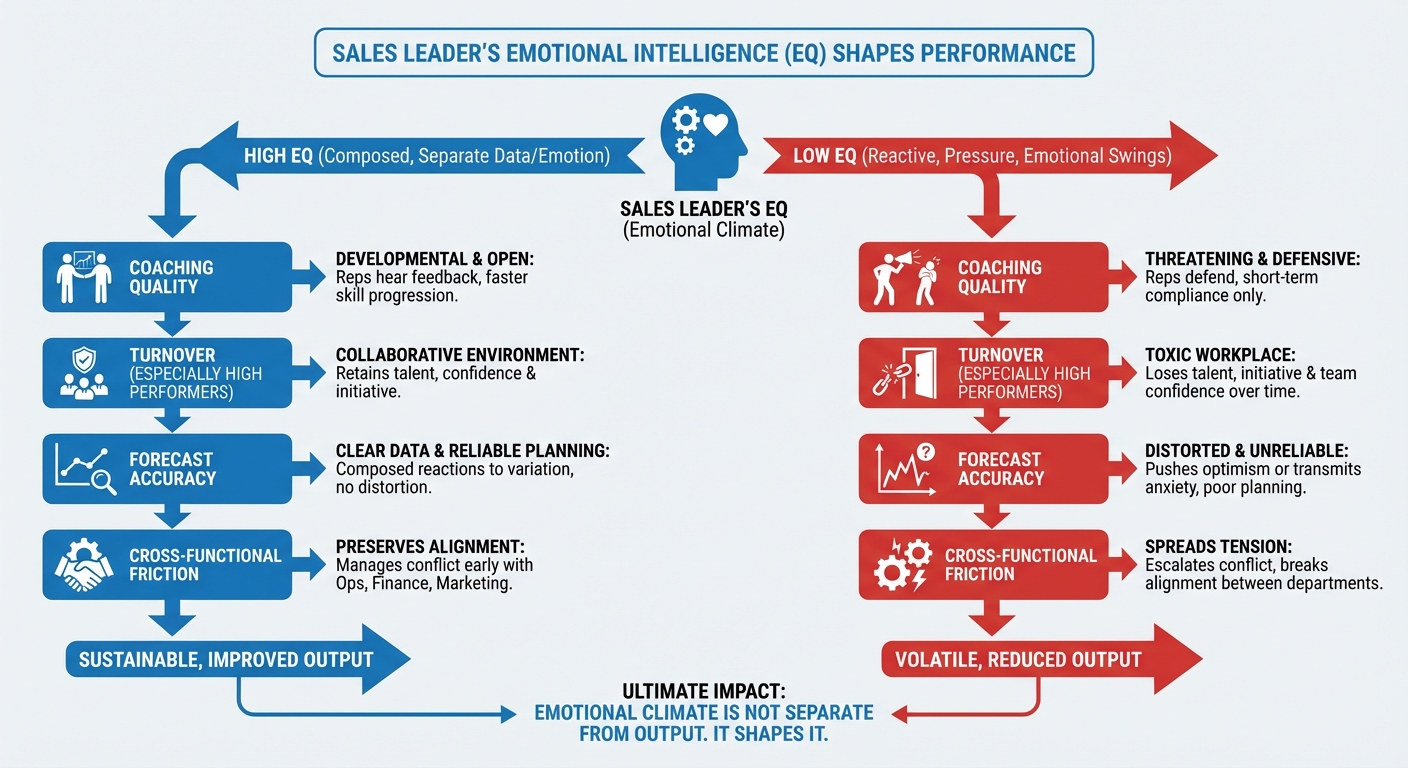
First, it shapes the quality of coaching conversations.
When your sales leader separates data from emotion in pipeline reviews, reps stay open. They hear feedback instead of defending themselves.
Improvement happens faster because the conversation feels developmental, not threatening. You get better skill progression instead of short bursts of compliance.
Second, it influences turnover – particularly among your stronger performers.
Talented salespeople rarely leave because of targets alone. They leave because of how they’re managed. They do not want a toxic workplace.
So – if your leader defaults to pressure, public correction, or emotional swings, you may see short-term effort. But over time, you lose team confidence, team initiative, and eventually lose talent. Because high performers expect a collaborative environment.
Third, it affects forecast accuracy.
Emotionally reactive leaders distort forecasts. Under pressure, they push optimism to reassure you. Or they transmit anxiety that causes deals to be called early.
If your sales leader stays composed when progress is uneven, you get clearer data and more reliable planning downstream. That’s because they don’t romanticize the sales journey. They expect variation, and lead the team steadily through it.
Fourth, it reduces friction beyond the sales team.
If your sales leader escalates conflict with operations, finance, or marketing, the tension spreads quickly.
But if they manage conflict early and seek a workable solution, you preserve alignment. And alignment between departments supports performance far more effectively than intensity alone.
In short, the emotional climate of your sales team is not separate from output. It shapes it.
That’s why emotional intelligence in sales leadership directly drives business performance. You’re protecting good team culture and consistent productivity.
It’s worth looking at the downside of ignoring EI…
The Cost of Overlooking Emotional Intelligence in Sales Leadership
Why is emotional intelligence important in sales leadership? Because there’s always a cost in making the wrong appointment.
When you appoint a sales leader based primarily on revenue history, you risk losing stability.
Prioritizing drive without assessing emotional maturity often delivers short-term push at the expense of long-term cohesion. Targets may still be met for a while. But underneath, you begin to see team fatigue, defensive behavior, and rising friction.
You might notice:
- Higher rep turnover than expected
- More escalations landing on your desk
- Forecast volatility that feels emotional rather than analytical
- Strong personalities competing rather than collaborating
Pressure is guaranteed in sales. But the differentiator is in behavior: how it’s handled. Handled badly, you pay a cost in poor ROI.
Can Emotional Intelligence in Sales Leadership Be Assessed or Developed?
So: What is emotional intelligence in sales? It’s a good question because emotional intelligence is observable. And it is developable.
Briefly, these are the skills and behaviors you’re looking for: self-awareness of emotional state and how it will affect others; self-regulation to manage emotions calmly; motivation – using delayed gratification to go for the bigger picture; empathy with clients and team; and social skills for team building.
To assess these skills in interviews – or in prior observations – ask or watch for specific examples:
- How did they handle a missed target personally?
- How have they recovered a struggling rep?
- When did they manage conflict early rather than escalate it?
- How do they conduct a difficult pipeline review?
Listen for emotional control under commercial pressure – not just commercial success.
If you’re developing an existing rep into sales leadership, structure matters: regular coaching sessions, clear feedback loops, observation of real review sessions, honest 360 input with reflection time.
Their emotional intelligence strengthens when reflection becomes habitual. Choose the right people, and structured coaching, awareness, and discipline will do the rest.
360 Consulting Can Help Develop Emotional Intelligence in Sales leadership
Emotional intelligence underpins leadership performance.
In modern sales environments, performance volatility is normal. Buyer behavior shifts. Cycles lengthen. Pressure intensifies. What must remain constant is the emotional climate of your sales team – because it drives growth.
We have decades of experience in sales leadership roles. If you want to strengthen emotional intelligence in sales leadership in a practical, operational way – not as theory, but as a leadership discipline embedded in how you run your sales function – we can help you build it into the way you operate, quarter after quarter.
Give us a call and let’s talk sales leadership.