
Sales leaders don’t need to be constantly agog and excited about artificial intelligence. You already use AI-driven tools for data analysis, forecasting, and reporting, and none of that is new. What‘s increasing every day is the spread of large language models (LLMs) such as ChatGPT, Claude, and others into the day-to-day fabric of sales work.
You don’t need to chase every development (that would be a constant task!), but you do need to decide how – or whether – this class of tool fits into the way your sales department actually runs.
Many sales leaders have already experimented. You’ve tried tools, prompts, maybe even a small pilot as a reps’ assistant. For a while, it felt promising. Then it became too fiddly, fragmented, inconsistent, or simply not worth the mental overhead. So it stalled.
That’s usually a signal that LLMs were introduced in the wrong place, or in the wrong way.
In this article, we’ll look at why that happens – and outline a more intentional, practical route to using LLMs in sales leadership without adding hype or complexity.
Why LLMs Usually Fail to Stick with Sales Leaders
When LLMs first appear in a sales environment, they tend to arrive through individual use. One rep experiments with prompts. Another uses it to grab meeting notes. A manager tests a summary tool. Each attempt makes sense in isolation.
The problem is that none of this adds up to a shared way of working.
Because usage is personal and uncoordinated, outcomes vary wildly. Some outputs look helpful, others don’t. Human input is mostly crucial.
There’s no consistent standard, no common reference point, and no reliable way for you, as a sales leader, to see whether any of it is improving how sales actually runs.
At that point, LLMs can start to feel like optional extras rather than part of the modus operandi of the team as you’d hoped.
The frustration is understandable.
As a sales leader, you’re not short of tools or information. What you’re short of is clarity – especially early clarity – about
- where deals are drifting,
- where judgment calls are being made under pressure, and
- where intervention would make a real difference.
This is the gap we’ll address next.
What Sales Leaders Actually Need from LLMs
If you’re leading a sales team, you’ve probably had some real LLM gains at the individual level.
But what matters more to you as a sales leader is visibility.
You need a clear sense of how deals are progressing across the team, where momentum is building, and where it’s quietly leaking away.
You need to spot when process is being interpreted loosely under pressure, when activity looks healthy on the surface but isn’t moving decisions forward, and when intervention would help now rather than after the numbers are in.
That kind of understanding usually comes from your years of experience in sales.
You’ve built it up by listening to calls, reading between the lines in CRM notes, and noticing patterns that aren’t immediately obvious.
The challenge, however, is scale. As teams grow and your deal volume increases, it becomes harder to maintain that level of insight consistently.
This is where LLMs become helpful, and also a time saver, to you as a sales leader.
Used deliberately, they can surface patterns across deals and conversations that are already happening, drawing your attention to emerging signals rather than isolated events.
In that role, an LLM operates quietly in the background, supporting your judgment. It gives you earlier, clearer information about how selling is actually unfolding.
How to Set This Up So It Actually Helps Sales Leaders Lead
At this point, the useful question is: What do you need in place so LLMs support your sales leadership rather than remaining a side experiment?
Your role here is to be clear about what you want the system to observe, compare, and surface, so you can brief your tech team accordingly.
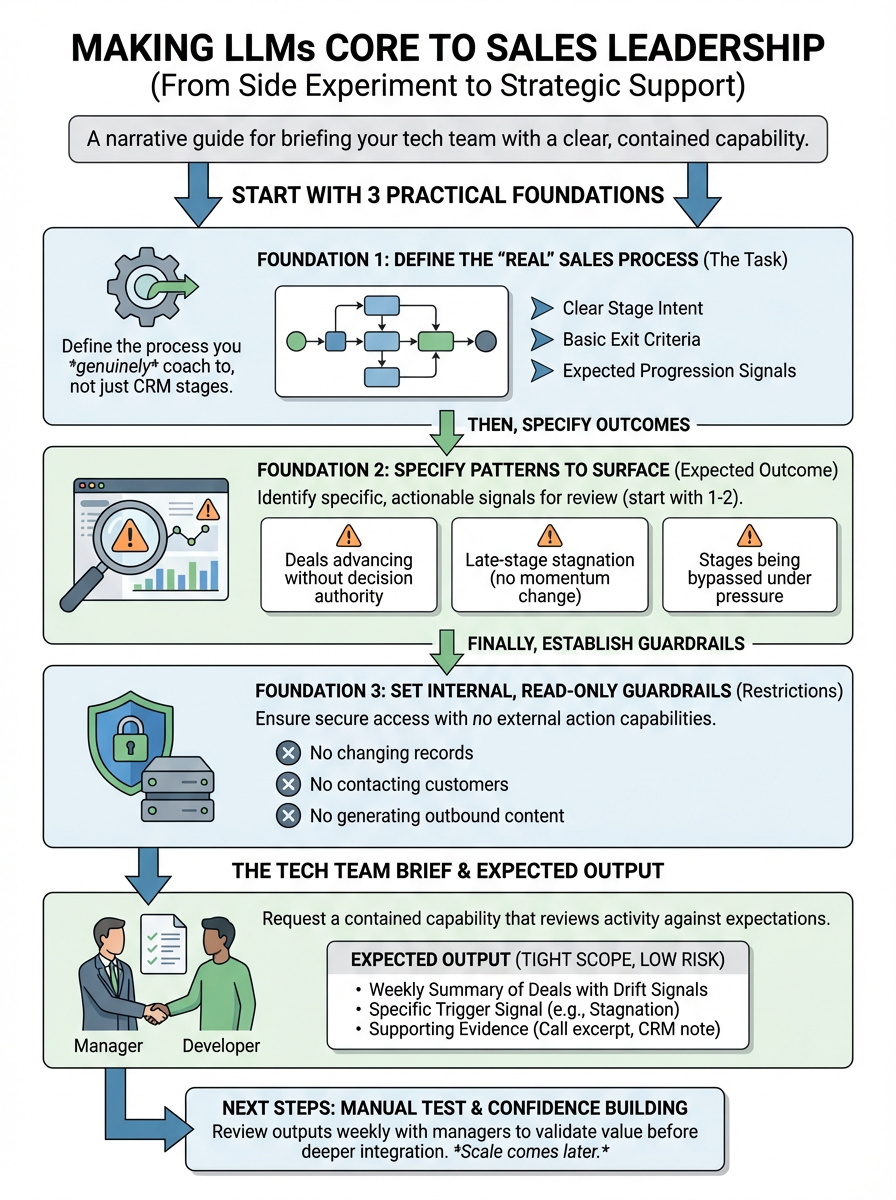
Start with three practical foundations and explain these clearly to the dev guys who will load and prompt the LLM for you.
Three foundations you need from them
First, be explicit with tech about the sales process you want observed. (The task)
This needs to be the version you genuinely coach to (in your playbook!), not the one that exists only as CRM stage names. Clear stage intent, basic exit criteria, and the signals you expect to see as deals progress are enough.
Second, define for tech the patterns you want surfaced. (Expected outcome)
This might include deals advancing without evidence of decision authority, repeated late-stage activity with no change in momentum, or stages being bypassed under pressure. One or two signals is plenty to start.
Third, keep the LLM internal and read-only. (Restrictions/guardrails)
In practical terms, this means secure access to existing sales data – CRM entries, call summaries, deal notes – with no ability to change records, contact customers, or generate outbound content.
When you talk to your tech team, you’re asking for a contained capability that periodically reviews sales activity against agreed expectations and surfaces exceptions for management review.
It’s helpful to be quite specific about the output you expect. For example:
- a short weekly summary of deals showing drift signals
- which signal was triggered
- the supporting evidence (call excerpt, CRM note, or activity pattern)
That framing keeps the scope tight, the risk low, and the purpose clear.
Once those foundations are in place, you can test the value manually – reviewing outputs weekly with a sales manager – before deciding whether deeper integration is warranted. The goal at this stage is simply gaining confidence to move forward with an internal LLM. Scale comes later.
Why This Approach Tends to Stick
For sales leaders who’ve already tried using LLMs and moved on, this approach feels different because it fits how sales leadership already works.
It aligns with existing management “events” – deal reviews, pipeline conversations, coaching discussions – and supports your judgment rather than competing with it. It stays deliberately narrow, solving one leadership problem well.
Because the LLM is used to surface patterns rather than intervene directly, it earns your trust. Your reps don’t need to learn a new system. You are alerted to drift sooner and address it while it’s still easy to fix. Clarity appears where it’s genuinely useful.
That’s often the difference between an LLM experiment that fades away and a capability that becomes part of how sales leadership operates.
360 Consulting Can Help Sales Leaders Use an LLM as an Effective Tool
If you’re thinking about where LLMs could genuinely support sales leadership in your business – and want a practical way to put that structure in place, we have decades of experience in sales leadership in all verticals. Let’s talk.