Successful sales teams can hit a growth ceiling when the methods that helped the business reach its current size are no longer enough to support the next stage. Scaling sales requires repeatable processes, clear targets, reliable data, and a way for good performance to be reproduced across the whole team.
It can be a frustrating position for a successful business.
You have experienced salespeople. Revenue may have grown steadily for years. Your best reps know their customers, understand the market, and have developed ways of selling that work.
You maybe at one time stepped back and reviewed the structures supporting your business and made some updates.
Yet at some point, growth slows or seems to stop altogether.
We’ve worked with businesses in exactly this position. Often, there’s no single point of failure. The business has simply reached the limit of what its existing approach can reliably deliver.
You then have a conundrum. Because adding more activity, setting higher targets, or recruiting more salespeople may not solve the problem. If the underlying sales operation can’t scale, those actions can simply put more pressure on weaknesses that already exist.
Performance problems usually leave clues. When you look more closely at how your team targets prospects, qualifies opportunities, moves deals forward, and measures results, you can begin to see what needs to change before the business can grow consistently again.
Understanding how successful teams can hit a growth ceiling is a good place to start.
Can a Sales Team Rely Too Heavily on Its Best Performers?
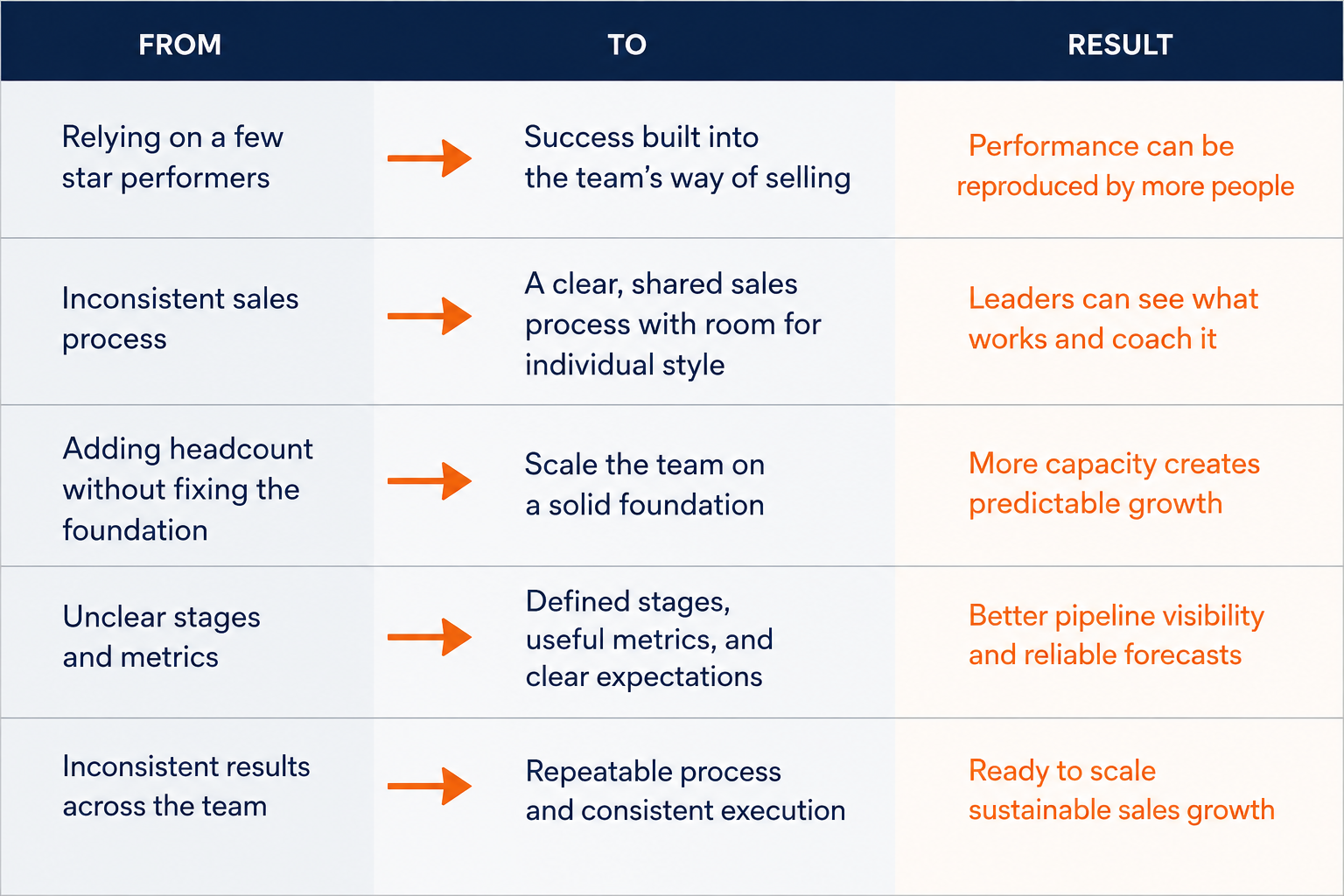
Yes. Strong salespeople can drive impressive growth, but a business becomes vulnerable when too much of its success depends on what a few individuals know and do.
Their methods may work extremely well. The problem comes when you cannot easily teach, measure, or repeat those methods within the whole team.
We see this particularly in businesses that have grown successfully over a number of years.
Imagine a company with six sales reps. Two consistently produce outstanding results. They know which prospects are worth pursuing, ask the right questions, recognize when an opportunity is serious, and instinctively know when to push a deal forward.
Ask them exactly how they do it, though, and you may get a less useful answer: “You just know.”
That works while those two people keep delivering. It becomes a problem when you want the other four reps to perform at the same level. It becomes a bigger problem when you hire four more.
The answer isn’t to turn your best salespeople into robots or force everyone to copy the same selling style. The way forward is to understand what sits behind their success. For example:
- Which behaviors can be identified?
- Which decisions can be turned into a process?
- What knowledge should be shared across the team?
Your strongest reps should remain strong individuals. But some of what makes them successful needs to become part of the way your business sells.
That gives you something you can teach, coach, measure, and eventually scale.
How Does an Inconsistent Sales Process Limit Growth?
An inconsistent sales process makes growth harder to repeat. When reps qualify prospects differently, move opportunities forward on different criteria, or follow their own methods, your leaders have less control over what produces results. Scaling sales becomes much harder because there’s no reliable model to build on.
Some freedom in how people sell is healthy.
Your reps have different personalities, strengths, and ways of building relationships. That doesn’t mean every part of the sales process should be personal to them.
If one rep qualifies an opportunity after a detailed discovery conversation while another moves a prospect forward because they seemed interested, those opportunities don’t mean the same thing. Yet they may sit at exactly the same stage in your CRM.
That makes the pipeline harder to assess and forecasts less reliable.
It also makes coaching difficult. A sales leader needs to know what should be happening at each stage before they can work out where a rep needs help.
A consistent process gives everyone that common foundation – while still leaving room for people to sell like people.
Can Hiring More Salespeople Make the Problem Worse?
Yes. Hiring more salespeople can magnify weaknesses in an existing sales operation. If targeting, qualification, sales stages, or expectations are unclear, every new hire has to interpret them. You may increase activity without creating the predictable growth you expected.
Suppose five reps are already working in five slightly different ways. Add another three without fixing the process and you haven’t necessarily increased your sales capacity. You may simply have eight different approaches to manage.
New hires also need something solid to learn from. “Watch what our best rep does” isn’t a scalable onboarding strategy.
Before increasing headcount, ask what those additional people will be stepping into:
- Do you know which prospects they should prioritize?
- What qualifies as a genuine opportunity?
- What should happen next?
- Which numbers will tell both the rep and their manager whether things are working?
Hiring can then increase the capacity of a functioning sales engine instead of placing another load on an unreliable one.
What Does a Sales Process Need Before It Can Scale?
A scalable sales process needs clear targeting, agreed qualification criteria, defined sales stages, useful metrics, and consistent expectations about how opportunities move forward. It should give salespeople enough structure to repeat what works and give leaders enough visibility to coach performance and make informed decisions.
That doesn’t mean creating a giant sales manual that nobody opens after their first week!
The process needs to reflect how your customers actually buy and how your business successfully sells.
Your ideal customer profile should guide prospecting.
Qualification should prevent reps wasting time on opportunities that are unlikely to go anywhere.
Sales stages should represent genuine progress rather than hopeful labels in a CRM.
Then your numbers start to mean something.
You can see where opportunities stall, where conversion is strong, and where individual reps may need coaching. You can also identify successful behaviors and reinforce them across the team.
That’s when process becomes useful rather than bureaucratic. You haven’t strangled personality. You’ve set them free on a sound basis.
How Do You Know Your Sales Team Is Ready to Scale?
A sales team is ready to scale when good results no longer depend mainly on particular individuals. Leaders understand how the team creates opportunities and converts them. Reps work from a shared process, performance can be measured meaningfully, and new people can learn how the business sells without having to invent their own approach.
You don’t need perfection before you grow. Few sales organizations ever reach it.
But you should be able to explain why your sales process works.
If you can identify your best prospects, show how opportunities progress, understand the numbers behind conversion, and coach people against an agreed way of working, you have something you can build on.
If you can’t, adding more targets, activity, or people may produce growth for a while. It may also take you straight back to the same ceiling.
This is the wrong approach and the senior leaders we work with sense this. They’ve seen the warning signs. They know what they don’t know and are humble enough to ask for help that pushes through that ceiling to scale their sales.
So – scaling sales successfully means making more of what works repeatable.
That’s how a business moves beyond relying on a handful of talented people and builds a sales operation capable of supporting its next stage of growth.
360 Helps You Build a Sales Operation That Can Scale
If your sales growth has reached a ceiling, we can help you identify what needs to change and work with you to build a sales process that supports your next stage of growth.
Talk to us about scaling your sales.
Image © 360consultingdfw.com via ChatGPT