
Knowing how to identify business problems means recognizing the patterns that repeat throughout your business.
Every significant problem leaves evidence behind. The challenge is learning how to read those fingerprints before you decide on a solution. We’ve seen how easy it is for leaders to fall into solution territory before diagnosis simply because they need a fix as soon as possible.
However, business problems and solutions are best brought together by astute diagnosis.
The first step is to stop chasing symptoms and start looking for patterns.
Why?
Because problems rarely pop up in a board meeting and say, Hey, I’m the problem – but they almost always leave fingerprints (evidence) behind.
Learning to recognize those fingerprints makes diagnosis faster, decisions more accurate, and improvement far more likely.
Why Business Problems Leave Fingerprints
When the same outcome appears again and again, it’s unlikely to be due to chance.
Patterns develop because something underneath keeps producing the same result. It’s pointless to merely react to the latest incident. You need to discover what connects this incident to the last five.
That’s why experienced consultants often spend more time asking questions than offering solutions. Good diagnosis nearly always beats fast diagnosis.
Here are some the main places we find fingerprints that act as evidence when you’re diagnosing problems in your business.
Some Business Problems Follow People. Others Follow Systems.
It’s very easy when you’re looking into strategies for declining sales revenues to blame people. Or a person. Even replace your VP of Sales. Sales performance is often a management system problem.
But it’s better to consider asking questions looking at the problem from both sides:
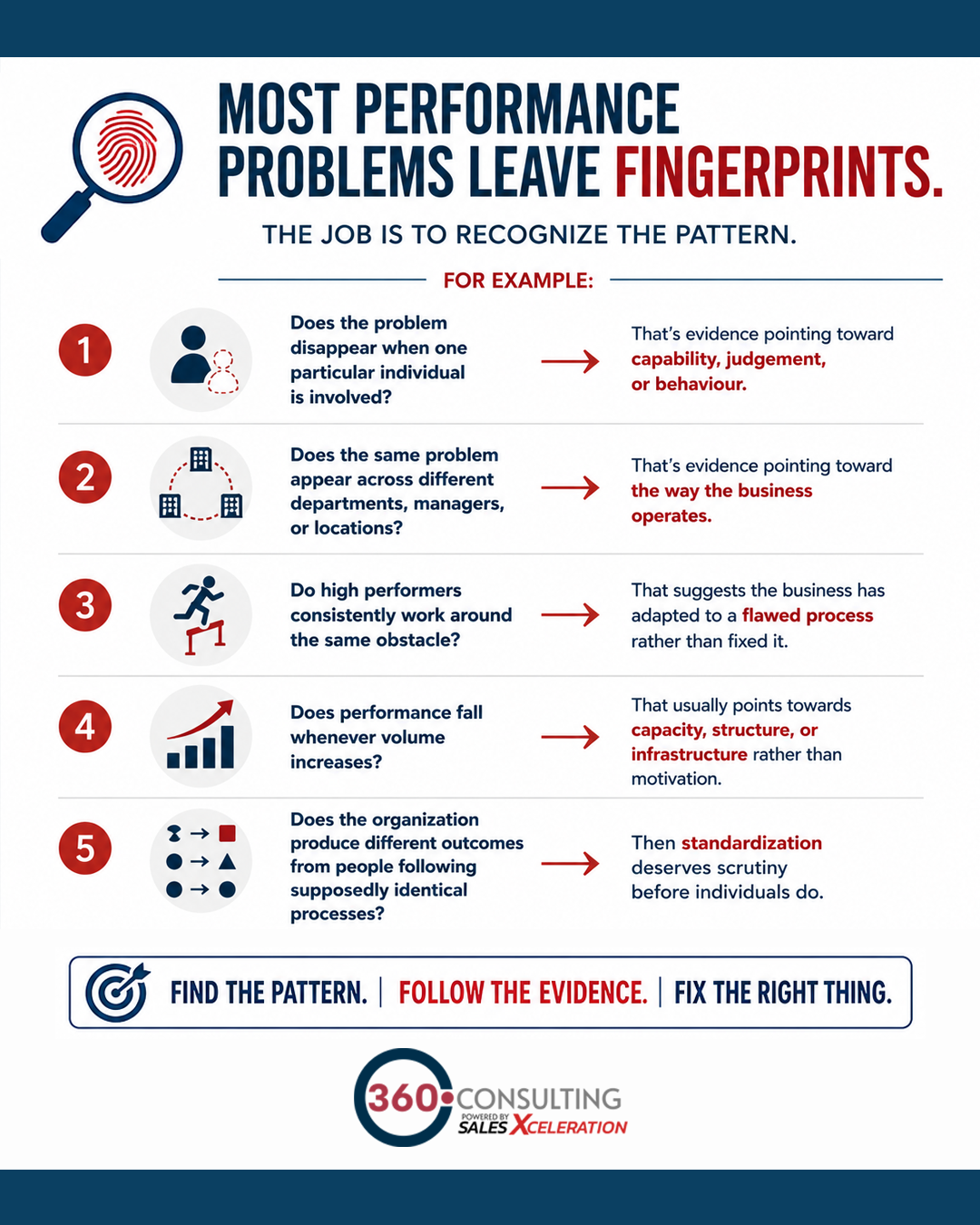
Does the problem disappear when a particular individual becomes involved?
Suppose one salesperson’s customer quotations vary wildly in quality until one senior salesperson reviews them. The issue may have very little to do with your pricing process. Instead, it points toward experience, judgment, or capability.
Your capable salesperson solved the problem – indicating the problem originated in lack of experience. Possibly lack of training or mentoring.
Now reverse the situation.
Different people prepare the quotations. Various managers approve them. Different regions handle the work. Yet customers still receive inconsistent proposals.
Does the problem remain whoever was involved?
The fingerprint has changed. The evidence now points away from individuals and toward the way your business operates. Perhaps the playbook isn’t clear, or is out of date – or perhaps nobody enforces consistency in using it.
We’re pointing this out because coaching a person who’s less experienced will never solve the problem if you need to repair a broken system.
And, conversely, redesigning a process won’t solve a capability gap.
The next business problem that leaves clear fingerprints is ownership…
Unclear Ownership Leaves Its Own Fingerprints
Businesses often struggle because everybody assumes somebody else owns the problem.
Imagine a customer requesting a small contract change. Sales believes Operations should approve it. Operations expects Finance to decide. Finance waits for Legal. Three days later the customer still has no answer, while every department believes it has acted reasonably.
Nobody refused. But nobody accepted responsibility. The fingerprint of this chain of failure is in every department.
Decision-making and who owns the process at every stage is a key place to look when you have business management problems. Which managers are passing upwards instead of deciding?
Missing Information Causes Business Problems
People make surprisingly good decisions with the information they have.
The real danger begins when different people work from different versions of reality. This often happens when CRM management is poor.
One manager believes a product line performs well because revenue continues to grow. Another sees shrinking margins. A third focuses on customer returns. No one is wrong, but no one is seeing the whole picture.
Soon they begin pulling your business in different directions for perfectly logical reasons.
When those different viewpoints finally collide, it’s easy to assume someone made a bad decision. In reality, each manager acted on the information available to them.
The fingerprint is the fragmented information. When you discover a pattern of information gaps in different departments, you can make a better diagnosis of how to solve the issues.
Timing Can Reveal Hidden Business Problems
Many leadership teams ask who caused the problem. Finger-pointing is common even in top teams. It’s human.
One of the questions we ask you when consulting is this: When does the problem appear?
Perhaps customer response times collapse only during major product launches. Or service quality falls every August when experienced staff take vacation. Maybe production errors spike only after large orders arrive from a single customer.
The timing itself becomes evidence.
Without asking when, leaders often blame people for conditions that are in fact due to the business context itself.
Diagnose Business Problems Before You Solve Them
Strong businesses don’t eliminate every problem. But they do become better at identifying the right problem and the right cause.
Observing what’s going on in the business – looking for the recurring fingerprints pays much faster dividends than making assumptions.
- Look for what repeats.
- Notice where responsibility becomes uncertain.
- Ask whether the evidence follows people or follows systems.
- Pay attention to what information is missing and when the problem appears.
Those fingerprints won’t tell you the whole story but they do tell you where to start looking and diagnosing.
And in business, the quality of the diagnosis will determine the quality of every decision that follows.
Frequently Asked Questions About Business Problems
Can AI help identify business problems?
Yes, but AI works best as an analytical tool rather than a decision-maker. It can uncover patterns in sales performance, customer feedback, operational data, and financial reporting that people may overlook. What it can’t do is replace executive judgment. AI may reveal the fingerprint; experienced leaders still have to diagnose the cause and decide what action to take.
Does leadership training help solve business problems?
It can, if the underlying issue involves leadership capability. If unclear ownership, poor processes, or fragmented information are causing the problem, sending managers on another training course is unlikely to produce lasting change. Good diagnosis should always come before selecting the solution.
Who can help diagnose business operational problems?
Businesses often bring in external consultants because they themselves are too close to the day-to-day operation to see recurring patterns objectively. An experienced advisor looks beyond individual incidents and searches for the evidence that connects them. That often leads to faster decisions and avoids investing time and money in solving the wrong problem.
Why do the same business problems keep coming back?
Recurring problems usually point to an underlying cause that has never been addressed. Fixing the visible symptom may provide temporary relief, but unless the underlying process, ownership, leadership, or information issue changes, the same problem often returns in a different form.
Diagnosing Business Problems with 360 Consulting
If you need an experienced set of eyes to help diagnose persistent business problems, we’re here to help. We’re known for telling it as it is. Book a free consultation and let’s talk.