Business growth often reveals decisions that no longer fit the company you now have.
At the time, those decisions usually made sense. You added a service to meet demand. Maybe accepted a customer segment because it generated revenue. Or you created an exception to win important work. The leadership structure you built suited the size of your business at the time.
The challenge comes now, when you’re looking for business growth.
Small-to mid-market companies always have to reassess as they grow. They’re the least able to absorb wasted resources. And waste often arises from structural debt.
We’re thinking here of structural debt in the same way we use the phrase technical debt: technology that’s legacy, unable to be updated, or with security vulnerabilities.
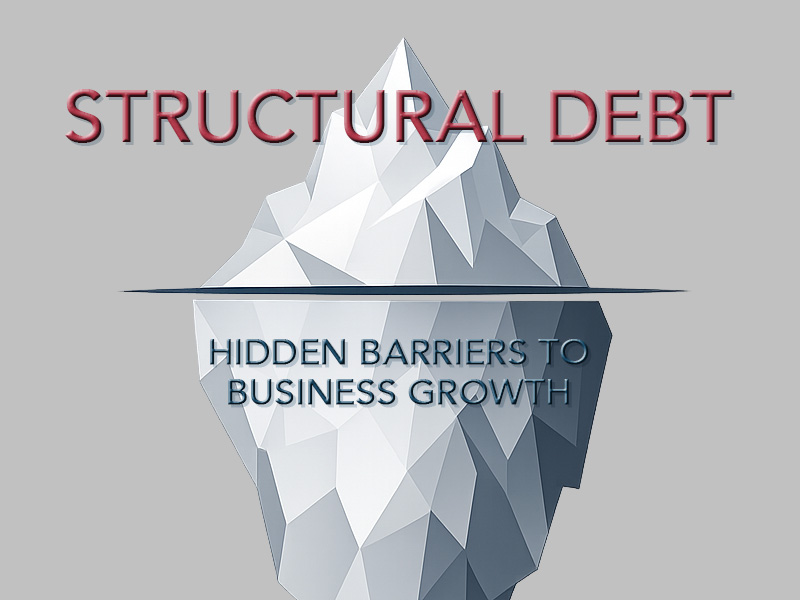
In a similar way, structural debt accumulates when past decisions continue shaping the business long after their value has declined.
You’ll often notice the changes as they show up in slower execution, diluted focus, unnecessary complexity, and reduced profitability.
Unlike a major operational failure, structural debt develops gradually. You may not even notice it until growth becomes difficult to maintain.
At that point – if not before – it’s good to look what the barriers might be that are limiting your organization’s growth.
Here are four common business growth barriers that often signal structural debt.
Business Growth Barrier #1: Customer Segments That No Longer Fit Your Strategy
Many companies continue serving customer segments that first made sense years ago.
Those customers may have helped build the business, but markets evolve and priorities change.
A segment that once supported your growth can eventually absorb too many resources, distract you from stronger opportunities, and complicate delivery. That’s because they’re a poor fit for the customers you’re now best positioned to serve.
Those customers were valuable in the past. But do they still fit the direction of your business today?
Ask yourself: Which customer groups are you serving simply because you’ve always served them?
Growth requires focus. Structural debt can weaken it. So, our recommendation is to be forensic in analyzing your customer segments to ensure a continuing good fit.
Business Growth Barrier #2: Product and Service Complexity
Most product and service portfolios expand faster than they contract. It’s easy to add in another variation. It feels like company growth. And why remove an older one? the thinking goes. It still sells periodically.
But each offering demands attention.
Someone must sell it, deliver it, support it, and maintain expertise around it, and provide documentation and videos that go with it. Over time, this complexity accumulates even though your revenue does not.
It’s a bit like smoke and mirrors: A broad portfolio can often create the appearance of opportunity. But actually, it’s increasing your costs and reducing clarity around your best focus for service and product offerings.
That complexity affects sales conversations, operational efficiency, and your market positioning.
So, a useful leadership question is: What would you stop offering if you were building the business from scratch today?
The answer often reveals where structural debt has taken hold.
Business Growth Barrier #3: When Exceptions Become Standard Practice
Many business exceptions begin for a good reason.
A key customer needs something different. A process has to change in order to secure a contract. A special arrangement solves an immediate problem. And yes, it’s a win on the day.
Over time, however, these exceptions can become embedded in the way your business operates. What began as occasional flexibility has gradually become habit and complexity due to ever-increasing “exceptions.”
In our experience as consultants, we see that when teams develop workarounds, accountability becomes vague. Processes become harder to follow and more difficult to improve. Everyone defers the decision to challenge it.
Ask yourself: Which exception has become so common that nobody questions it anymore?
The answer may reveal hidden barriers to business growth that have become part of your everyday operations.
Simplification is now a leadership responsibility – time to wield the executive shears.
Business Growth Barrier #4: Leadership Structures Built for a Different Business
Growth changes what your leadership needs to look like.
Structures that worked well when your company was smaller often struggle under greater scale and complexity.
Decision-making becomes concentrated in too few people. Managers inherit responsibility without sufficient authority. Senior leaders spend time resolving issues that should have been handled elsewhere.
The leadership structure hasn’t necessarily failed. Or at least not up till now. It may simply belong to an earlier stage of your business and has become problematic in light of your growth goals.
Two useful questions for any leadership team are:
Which part of your leadership structure belongs to a smaller version of this company?
What would good leadership look like now?
As your organization grows, your leadership infrastructure must evolve with it.
Structural Debt Rarely Fixes Itself
We’ve found that structural debt rarely appears as a single problem in a business. More often, it shows up as a collection of small inefficiencies that your leaders gradually accept as normal.
Customer segments no longer fit the strategy. Complexity accumulates. Exceptions become routine. Leadership structures struggle to keep pace with growth.
Together, these issues create barriers that make your business growth slower than it needs to be.
In our experience, the strongest leadership teams are those who have the courage to periodically step back and review the structures supporting the business. Asking questions like the ones we’ve suggested.
For example, whether past decisions still serve current goals. Whether your organization remains aligned with the future you’re trying to create. Whether something needs to be updated.
It will not fix itself. It’s a C-suite problem now – because sustainable growth depends on the structure or architecture underneath your revenue targets and goals.
360 Consulting Helps Companies Build the Infrastructure for Sustainable Business Growth
As a group of experienced VP Sales, we work with business leaders to identify structural barriers that limit execution, accountability and sustainable growth.
That means helping you strengthen the infrastructure that supports sales performance, leadership effectiveness, and long-term business growth – so your organization is prepared for its next stage of development.
If your business is carrying structural debt, call us today and let’s talk.