
By mid-November, you’ve probably made most of your sales plans for 2027. Your targets are taking shape, budgets are being allocated, and you’ve identified where you want to improve performance.
But are you confident you’ve prioritized the changes that will make the biggest difference?
The most obvious sales performance problem isn’t always the one you need to fix first. Finding the underlying cause can save you from investing in solutions that won’t deliver the growth you expect.
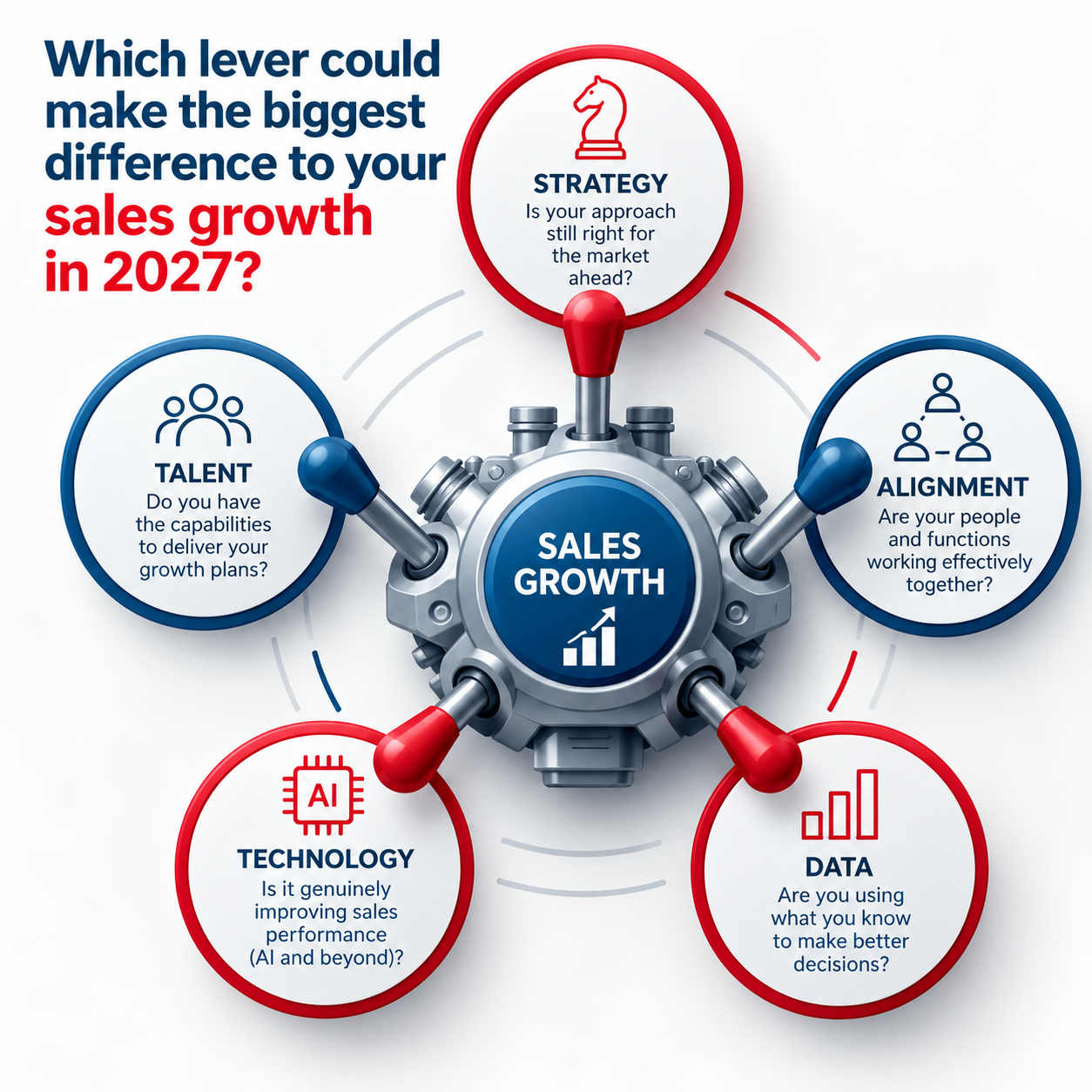
So, let’s review five levers that could influence your sales growth in 2027.
Which Five Levers Could Make the Biggest Difference to Sales Growth?
The following five levers don’t operate independently. A data problem might expose poor alignment between departments. What looks like a talent shortage could turn out to be a strategy problem.
So, identifying a weakness doesn’t automatically tell you where to invest. But it’s a powerful starting place in Q4 when making decisions for the year ahead.
Consider our five fictional businesses. Each faces a different challenge, and each illustrates how the right priority might be quite different from the one management initially considered.
1. Strategy: Are You Still Selling to the Right Market?
A regional industrial equipment distributor has enjoyed steady growth for years. Its salespeople know their customers, understand the products, and have built some excellent relationships.
But growth has stalled.
The sales director thinks the answer is to recruit two more reps and increase territory coverage. After all, the existing team is working hard, and there must be more business out there.
Then someone asks an awkward question at the planning meeting.
“Are we sure we’re still chasing the right business?”
It turns out that several major customers have changed how they purchase equipment. They’re looking for suppliers who can provide maintenance support, flexible purchasing arrangements, and more help managing equipment throughout its working life.
Meanwhile, the sales team is still concentrating on winning individual equipment orders, just as it always has.
The company hasn’t suddenly become bad at selling. But its approach may no longer match what its market wants.
Before increasing headcount, leadership needs to reconsider its target customers, value proposition, and route to market.
Pull the strategy lever when your existing sales approach no longer reflects where the best opportunities lie.
2. Alignment: Is Sales Growth Creating Problems Elsewhere?
A commercial construction services company has had a pretty good year. Its sales team has won several major contracts, and the pipeline looks promising.
So why is the operations director looking increasingly unhappy?
Because some of those contracts include delivery schedules and service commitments that are proving difficult to meet.
Salespeople are doing what they’ve been encouraged to do: winning business. They’re also making promises based on what they believe the company can deliver.
Unfortunately, nobody has established a reliable way to check those assumptions before contracts are signed.
Operations is stretched, customers are becoming frustrated, and the sales team feels unfairly criticized for bringing in revenue.
The CEO initially considers tightening sales targets and introducing more oversight. But the problem isn’t really sales performance.
It’s how sales and operations work together.
The company needs clearer agreement about capacity, commitments, and handoffs. It may also need to reconsider which opportunities are worth pursuing.
Adding more sales activity now could make matters worse.
Pull the alignment lever when different parts of the business are working hard but aren’t working effectively together for sales growth.
3. Data: Can You Trust What Your Sales Numbers Are Telling You?
A mid-sized professional services firm has a forecasting problem.
Every month, the managing partner asks for an updated sales forecast. Every month, the numbers look encouraging. And every month, actual revenue comes in below expectations.
The sales director is fed up. The CRM must be inadequate, surely? Perhaps it’s time to replace it with something more sophisticated.
But a closer look reveals the problem.
One account manager records an opportunity as highly probable after a promising introductory meeting. Another waits until the prospect has confirmed a budget and decision-making process.
Several opportunities haven’t been updated for weeks. Others have close dates that keep moving forward without any explanation.
The CRM is faithfully reporting the information people enter. Unfortunately, that information doesn’t mean the same thing across the team.
A new system might offer better dashboards, but it won’t automatically make the underlying data more reliable for sales growth.
The firm needs to agree on opportunity stages, qualification standards, and forecasting expectations. Managers also need to use those definitions consistently and insist on accurate recording.
Only then can leadership decide whether the technology itself needs improving.
Pull the data lever when unreliable information is leading you toward the wrong sales decisions.
4. Technology: Where Could Automation Make a Real Difference?
A specialty parts wholesaler has a different problem.
Its salespeople spend much of their day checking inventory, preparing quotations, chasing order information, and updating records.
Customers often need answers quickly, but a straightforward quotation can involve checking three different systems and sending several emails.
One experienced rep jokes that he spends more time looking for information than talking to customers.
Management has been hearing plenty about AI agents and advanced sales automation. Perhaps that’s the answer.
Possibly. But first, the company needs to understand exactly where time is being lost.
Could its existing systems be connected? Can inventory information become accessible in one place? Could standard quotations be generated automatically, leaving reps to concentrate on more complex customer requirements?
These aren’t particularly glamorous questions. Nobody is likely to give a conference keynote about eliminating duplicate data entry!
But solving those problems could give the sales team more time to sell and customers a much better experience.
The business may eventually benefit from AI-powered tools. For now, relatively straightforward improvements could deliver the greatest value.
Pull the technology lever when the right tools could free up your salespeople to spend more time selling.
5. Talent: Do You Need More People or Better Performance From the Team You Have?
A business software provider has ambitious growth targets for 2027.
Its sales director wants to recruit four additional reps. There’s plenty of market opportunity, and the existing team is already busy.
But the CEO has noticed something odd.
Three experienced salespeople consistently exceed their targets. The rest of the team produces respectable activity numbers but struggles to convert opportunities into business.
Everyone sells the same software. Everyone has access to the same CRM, marketing support, and product information.
So what’s different?
When managers begin reviewing calls and observing customer meetings, some patterns emerge.
The strongest reps ask better questions. They recognize when a prospect hasn’t identified the real problem. And they don’t rush into product demonstrations before understanding what the customer needs.
Other reps are enthusiastic and knowledgeable, but they tend to explain features rather than explore business outcomes.
Recruiting more people might increase the number of conversations. It wouldn’t necessarily improve their quality.
Perhaps the first investment should be in coaching, structured practice, and sharing the approaches that already work within the business.
The company may still need those four additional reps. But wouldn’t it make sense to improve the performance of the existing team before expanding it?
Pull the talent lever when improving the capabilities of your existing team could deliver more growth than adding headcount.
How Can You Identify the Right Sales Growth Priority for 2027?
Start with the performance gap, investigate its causes, and test your assumptions before choosing where to invest.
The five businesses above have different problems, but there’s a common lesson. Each could waste resources by acting on the first explanation that seems reasonable.
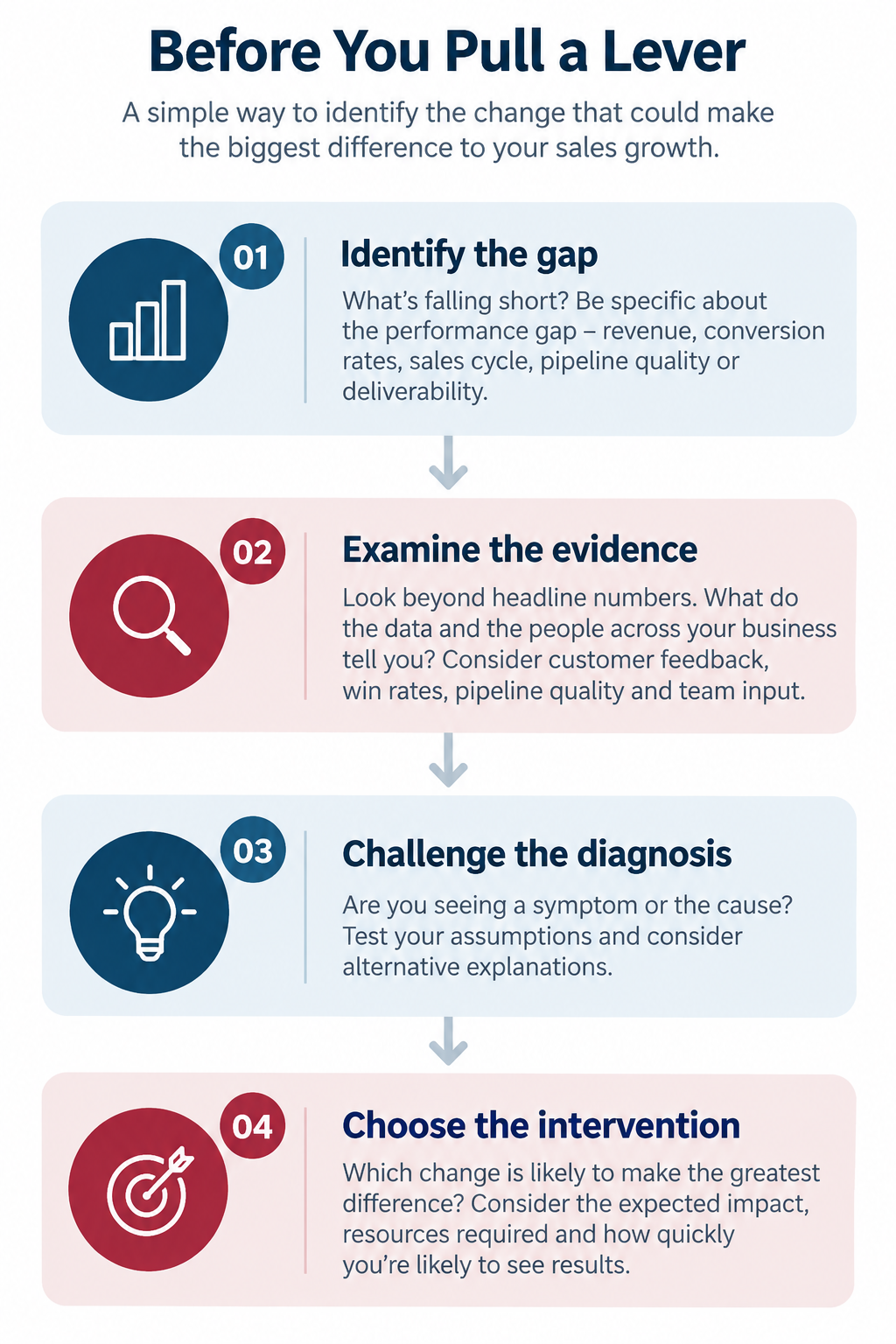
Before finalizing your sales growth strategy, we’d suggest four questions.
- What’s falling short?
Be specific about the performance gap. Is revenue below target? Are margins declining? Are opportunities taking longer to close? Is the business struggling to deliver what sales has promised?
A broad ambition to “improve sales” won’t tell you where to focus.
- What does the evidence tell you?
Look beyond headline revenue figures. Examine conversion rates, sales cycle length, pipeline quality, customer feedback, and the experience of people across the business.
Sometimes the most useful information comes from someone who isn’t in the sales department.
- Are you seeing the cause or a symptom?
Challenge your initial diagnosis. If conversion rates are disappointing, is the problem sales capability, lead quality, pricing, or something else?
Ask what evidence would support your explanation and what might contradict it.
- Which change is likely to make the greatest difference?
Consider the likely impact, resources required, and time needed to see results.
Some improvements can begin immediately. Others may require changes to your 2027 plans, investment priorities, or organizational structure.
And sometimes your investigation will confirm that your original priorities were right. That’s useful, too.
Is Your Sales Growth Strategy Ready for 2027?
You don’t necessarily need to rewrite your plans because you’ve identified an area that could perform better.
You may need to strengthen a process, improve collaboration, develop your people, or make better use of information and technology.
And remember that the five levers are connected. Pulling one may expose a weakness elsewhere. Improving alignment, for example, might reveal that your sales strategy needs adjusting. Better data might show that your team needs different skills.
The objective isn’t to improve everything at once. It’s to identify the change most likely to unlock meaningful growth as soon as possible.
There’s still time to take another look before 2027 begins!
Could 360 Consulting Help You Identify Your Next Move?
At 360 Consulting, we work with business leaders to understand what’s really affecting sales performance before recommending changes.
Our experienced sales consultants can help you evaluate your sales growth strategy, identify priorities, and put practical improvements in place.
If you’d value an experienced perspective on your plans for 2027, contact our team.